Paisley  |
A swirled pattern characterized by a teardrop shape. Popularized in Paisley, Scotland, during the 1800s, this design was originally an adaptation of a spade pattern found on Indian shawls. Today, paisley decorates everything from sheetings to fine dresses and always makes a statement of rich elegance. |
| Pajama |
A set of top and pants, designed for sleeping. From the Persian words pai for "leg" and jaman for "garment," pajamas were originally introduced in the 1800s for Indian men to wear as an alternative to the nightgown. Today, pajamas--or pjs--are classic sleepwear for both men and women. |
| Pant |
A garment that closes at the waist and wraps loosely about each leg. |
| Patch pocket |
A flat, outside pocket stitched onto a garment |
| Pea coat |
A hip-length, double-breasted, jacket with notched lapels and buttons featuring an anchor motif. Originally made of wool, today the peacoat is interpreted in every fabric from corduroy to velvet. |
| Peaked lapel |
A lapel in which a V-shaped seam is formed where the collar meets it. |
| Peasant blouse |
A woman's blouse, usually in white cotton, with puffed sleeves that gather at the wrist, a squared neckline, embroidered trim and a loose fit. Adopted from national costumes of European countries like Romania and Poland, peasant bloused became popular for women in the 1960s and continue to evoke a handmade, casual, carefree character. |
| Pedal pushers |
A woman's pant with a straight leg that is cuffed and falls below the knee. So called because women wore these pants in the 1950s for bicycling, pedal pushers continue to reflect a sporty, casual, summertime appeal |
Pencil skirt  |
A women's skirt that is cut in a straight line from the hips to the hem. So called because the silhouette is as straight as a pencil, this classic skirt was created in response to the 1940s fabric shortages that forced designers to slim down women's garments. The pencil skirt continues to be a popular silhouette, especially for daytime office dressing. |
| Peplum |
A short section joined to the waistline of a women's blouse, jacket or dress. Named after the Greek peplos, an ancient women's garment, peplums first became popular in the 1800s when women's clothing began to mimic men's tailoring, and the peplum too the place of jacket tails. |
| Percale |
A closely woven, plain weave, spun fabric made from both carded and combed yarns. Percale sheeting is the finest sheeting available. The high thread count gives the fabric a soft, silk-like feel. |
| Peter Pan collar |
A rounded collar that lays flat on a shirt. Originally worn in costumes for stage adaptations of James M. Barrie's 1904 book, Peter Pan, the style has become popular in children's and women's shirts and dresses, offering an innocent charm. |
| Picot |
The small decorative loops that form an edging on ribbon and lace |
| Pile |
A fabric construction in which loops are added to the base. These loops can remain intact, or their tops can be cut. Terry cloth is an example of a pile fabric in which the loops remain intact, and velvet and corduroy are examples of pile fabrics in which the loops are cut and brushed. |
| Pill |
A small tangle or ball of fiber that appears on a fabric surface as a result of wear. The presence of pills on a garment is usually considered a flaw. |
| Pinking |
A zigzagged border produced from saw-toothed scissors |
| Pinpoint Oxford |
Combines the weaving techniques of poplin and oxford resulting in a fine yet durable fabric, perfect for dress shirts. |
| Pinstripe |
Crisp, thin, usually gray or white, evenly spaced lines woven into fabric that give suiting a classic office elegance |
| Pintuck |
A very narrow fabric fold stitched on the right side. Usually appearing in a series, this embellishing technique often decorates girls' and women's blouses and dresses and is defining featuring in the men's guayabera shirt |
| Pinwale Corduroy |
Corduroy at it's thinnest vertical row or wale |
| Piping |
A narrow bias-cut fold of fabric stitched into a seam to provide decorative embellishment. |
| Pique |
A durable woven or knit fabric that is characterized by an allover textured pattern, the most popular of which are the cord, diamond and honeycomb |
| Placket |
A strip of fabric running along a closure, usually to facilitate the taking on and off of a garment |
Plaid  |
A fabric in which bands of color running horizontally and vertically intersect to form squares. Plaids date back to the 1500s and now come in many patterns from argyle and gingham to madras and windowpane |
| Plain seam |
The simplest of seams, in which two edges of a fabric are sewn together on the back side and then pressed open. Plain seams should be used on fabrics that have a tendency to unravel |
| Plain weave |
The simplest of fabric weaves in which length and crosswise yarns interlace over and under, alternately |
| Pleat |
A fold of fabric made by doubling material over on itself. An ages-old tailoring technique, several types exist, most of which provide more volume to a garment for either decorative or utilitarian purposes |
| Plissé |
Fabric treated with a solution that shrinks parts of the goods to create a crinkle or pleated effect. |
| Ply |
A term used to refer to the number of single threads twisted together to form a yarn, the lowest ply thus being a two-ply yarn. Higher-ply yarn is often considered to be superior, as it is stronger, resulting in a stronger fabric and more durable garment |
| Pocket |
A piece of fabric affixed to a garment to carry items. Pockets date back to the fifteenth century and were originally purses that were affixed to belts or stored within skirts or breeches and accessed through holes. Pockets began to become part of the cut of garments during the sixteenth century, and over the years the design and functionality of the feature has evolved into the many options available today |
| Pointelle |
A knit fabric with a subtle allover openwork, usually geometric, design. Typically translated in a lightweight cotton knit, pointelle offers delicate texture to T-shirts, pajamas and childrenswear |
Polo shirt  |
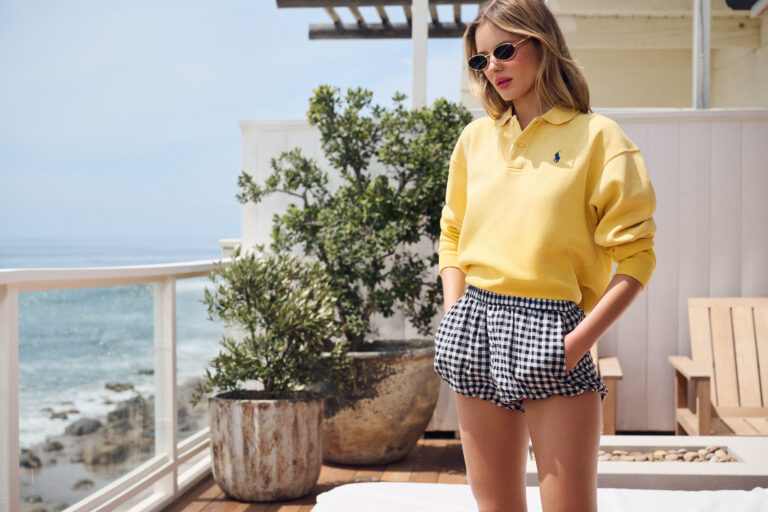
A knit pullover with a turned-over knit collar and placket at the neck. Originally worn by polo players because the collar stayed down during play, polo shirts became popular leisure wear in the 1930s, being worn by both men and women in fashionable summer resorts. Today, the polo is an icon of classic dressing that is continually evolving to the contemporary wardrobe |
| Poncho |
A garment that is basically a square or rectangular blanket with a center hole for sliding over the head. |
| Poplin |
A fabric with a fine horizontal rib effect on the surface because of a warp yarn finer than the filling yarn; usually a high thread-count cloth. Used in high-quality shirting. |
| Pouch pocket |
A large pocket placed at the center-front of a garment over the stomach area. So called because it mimics the pouch in which kangaroos carry their young, pouch pockets represent the ultimate in utilitarian style. Also called a kangaroo pocket |
| Prairie skirt |
A skirt that is flared from the waistline and has one of two rows of ruffles at the hem. Originally worn by American women settlers traveling west, the style has been adapted for modern use to reflect country appeal |
| Preppy |
In fashion, a term used to describe clothing and accessories inspired by private-school style. |
| Princess seams |
Seams used in a girls' or women's blouse or dress that follow the line from the mid-shoulder, through the apex of the breast, to either side of the belly button to provide a silhouette that follows the female form. |
| Print |
A fabric with a design applied to it. Prints date back thousands of years, and most countries have prints that are native to their land. Although many prints--such as batik-- are most beautiful when done by hand, technology has enabled the development of new printed effects, ensuring that prints will continue to evolve for years to come |
| Pull-on |
A term used to describe a pant or skirt that can easily be slipped on, usually with an elasticized waistline |
| Pullover |
A knit top that can be pulled on over the head |